Digital start-ups have upper hand over legacy companies for AI transformation.
Preface
Page xi: Exponential growth is usually invisible. It confronts you if you don’t acknowledge.
Page xi: AI is like Covid-19 virus that your business must get infected or your competitor will.
Page xxiv: AI powered firms does not rely on single algorithm. They focus on structured process that can deploy many AI solutions.
Page xxv: Becoming AI ready means keeping process simple and avoiding complexity. At the core, it’s a combination of right data, machine learning (ML) and algorithm.
1 – The Age of AI
Page 3: Every field is going to affect with AI. That includes art.
Page 4: Weak AI performs human’s repetitive task. Strong AI matches or beats human effort.
Weak AI is enough for company to start the transformation.
Page 5: Film photography beat painting. Digital photography beat film photography and gave birth to social media. The photos from social media are now feeding AI for image generation and facial recognition.
Page 6: The collision between digital and traditional technology not only creates higher quality, but also it changes value proposition for the customer needs.
Page 9: Amazon is a game changer in competition and transforming economy. They sell traditional goods on digital platforms.
Traditional company’s operating model becomes difficult as they scale over time. More employees leads to quality issues.
Amazon has upper hand over legacy firms because they have digitized their operating risk. Their order taking system can scale indefinitely.
Page 18: AI is new age that will transform the economy.
Analog and digital worlds are not separate anymore. AI is merging them.
Page 19: AI will kill traditional skills.
AI will give birth to new opportunities for start-ups, established firms, entrepreneurs, social, artists, economy and politics.
2 – Rethinking The Firm
Use Case 1 – Ant Financial
Page 25: Ant Financial, world’s largest FinTech’s secret is to leverage data to learn about customer needs and serve back via digital services.
Page 26: Ant Financial is great example of AI-powered company where ten thousand employees server 700 million users.
In contrast, American Express need 200,000+ people to server 70 million customers.
Three companies that successfully transformed into AI ready for the future.
- Ant Financial for banking technology
- Ocado for grocery
- Peloton for fitness
Page 27: The company’s value depends on two things:
Business model for creating and capturing value using product or service.
Operating model for delivering value to customer with right deployment method and market positioning.
Page 28: Company must identify precise customer problem to approach value creation before its positioning in the market.
Value could be different for same product such as car.
A Toyota’s value is reliability and affordability.
A Ferrari’s value is luxury and speed.
An Uber’s value is to share ride and save time.
Idea for unique value proposition – pay as you value.
Page 30: The goal of operating model is to
- Deliver value at scale
- Achieve feasible scope
- Learn to adapt the market changes
Executive’s top two challenges to survive and thrive are scope and scale.
Page 32: Digital firms differs over traditional companies when it comes to scale, scope and learning.
Page 33: Ant Financial succeed with help of AliPay who came up with third-party escrow idea as value proposition to hold and release payment. It resolved the trust issue between unknown buyer and seller for online retail business.
Ant Financial charges 0.6% fee to merchant and no charges to consumer.
AliPay focused on increasing users on the platform. More merchants lead to more buyers. It created the positive feedback loop.
Page 35: Ant Financial saw a market gap and opportunity on conservating Chinese bank who would limit credit, loan and investment products to average citizen.
Ant Financial launched Yu’e BAO platform where users can invest left over money for investment. Yu’e BAO became largest market fund with $81 billion dollars in 9 months.
Ant scaled beyond finance and technology. They expanded to medical, insurance, dining reservation, education, games and transportation.
Page 37-38: At the core of New Kind of Operating Model is sophisticated and integrated data platform.
Ant Financial collects data from various sources: customer behaviour, seller transactions and business partners. They also tap government platforms for citizen data.
3-1-0 System: Mybank utilizes this approach where it takes three minutes for customers to apply for the loan, one second for the approval and zero human interaction.
Page 40-41: The essence of digital operational model is
- To remove direct human interaction or human bottleneck. It’s easier to scale with digital cloud computing resources.
- A fully digitised process can easily plug in with external partners, providers, communities or individual. The same process can be rinse and repeated with multiple domains. (Example – Peloton API can connect to Apple Health, Strava and FitBit)
- A vast amount of data speeds up learning and innovation
Page 42: John Foley, Peloton Founder says “Instead of wasting time with competitors who are superior at scale, scope and learning with AI capabilities, find a traditional category and transform into digital.”
Use Case 2 – Peloton (eBike Fitness)
Page 43: Peloton’s Business Model
- Transform analog product such as bicycle into digital Peloton Bike. It provides analytics and connectivity with fellow bikers community.
Questions
- What’s the analog for traditional learning?
- How it can be transformed digitally?
- Do people pay out of fear or motivation? or they are interdependent?
Food For Thought
- Professionals can de-reference their scenario and fit with CaaART framework to submit base content for DOC production.
Page 45: Peloton collects user’s PII (name, email, phone), PHI data (heart monitor) and psychological profile such as music or food taste. All data is feed to AI for product improvement.
Human beings can do everything that AI can do. They just can’t do it at scale. — Anne Marie Neatham
Use Case 3 – Ocado (Online Grocer)
Page 47: Ocado is an AI company disguised as supply-chain company disguised as online grocer.
Page 48: Ocado’s machine learning (ML) never stops. Their single warehouse is size of eleven soccer fields!
Ocado’s team theme is to visualise, trail it, then iterate, iterate, iterate and iterate in volume.
Page 49-50: How these three companies create, capture, transform and deliver value
Ant — Information based service
Ocado — Product delivery and supply-chain
Peloton — Tightly integrated product and service combination
Idea: Peloton is driven by network and community. Company takes customer as content creator and amplifies their data to broader customer with analytics and streaming services.
Page 51: Sundar Pichai, May 2017 – AI First
Google’s heavy investment on AI over two decades made a statement that AI is not an innovation, AI has moved to the centre of the company. Every Google product and service will use AI at the core for every interaction they do with the customers.
3 – The AI Factory
Page 53: Three things required to make a scalable AI factor
- AI Algorithm: to make predictions and influence decisions
- Data pipeline: to feed Algorithm
- Software: For connectivity and infrastructure to power algorithm and data pipeline
The product had limitation when manufactured as a solo in craft shop.
The scale changed after industrial revolution but the decision making and analysis were still traditional.
AI Factory is a scalable decision engine of 21st century.
Page 54: AI has became the core centre of the business. Humans have pushed to the boundary for value delivery away from the critical path (core).
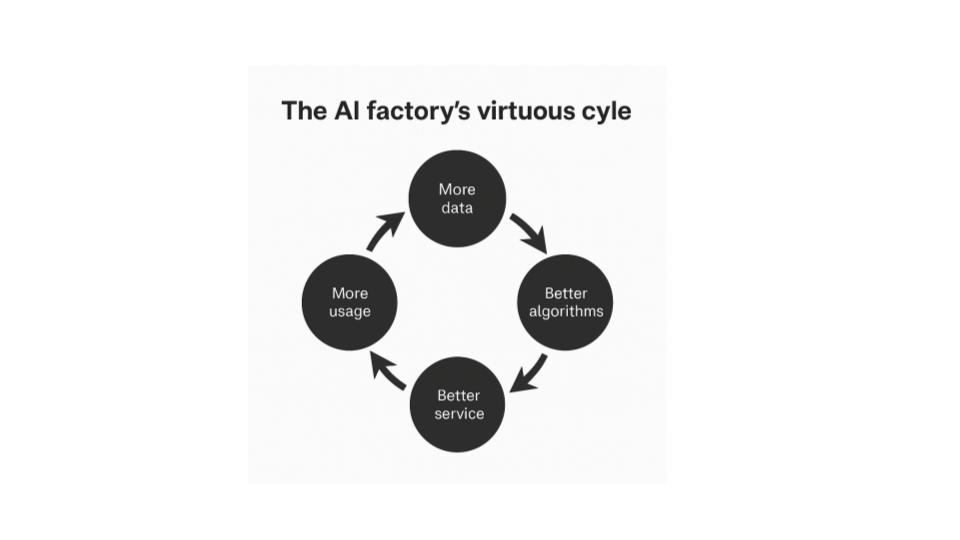
Data is used to get more data to improve algorithms which improves service that further drives more usage and that drives more data.
Example – the more people search and type better the prediction will be such as Google’s auto-complete the search or phrase in Gmail.
Building and Running AI Factory
Page 56: No company can become AI Factory without strong data foundation.
Netflix was early in the game of prediction.
Even in the DVD days, Netflix used recommendation engine based on viewer’s watching history and selling data to studio to get better deals.
Page 57: Netflix was pioneer in AI for auto launching next episodes in 5 seconds. You can blame Netflix for binging TV shows!
Netflix users consume 15% of global Internet bandwidth.!
? How does Netflix self-create content works (Reference: House of Cards) ?
Page 58: AI Factory Compoents
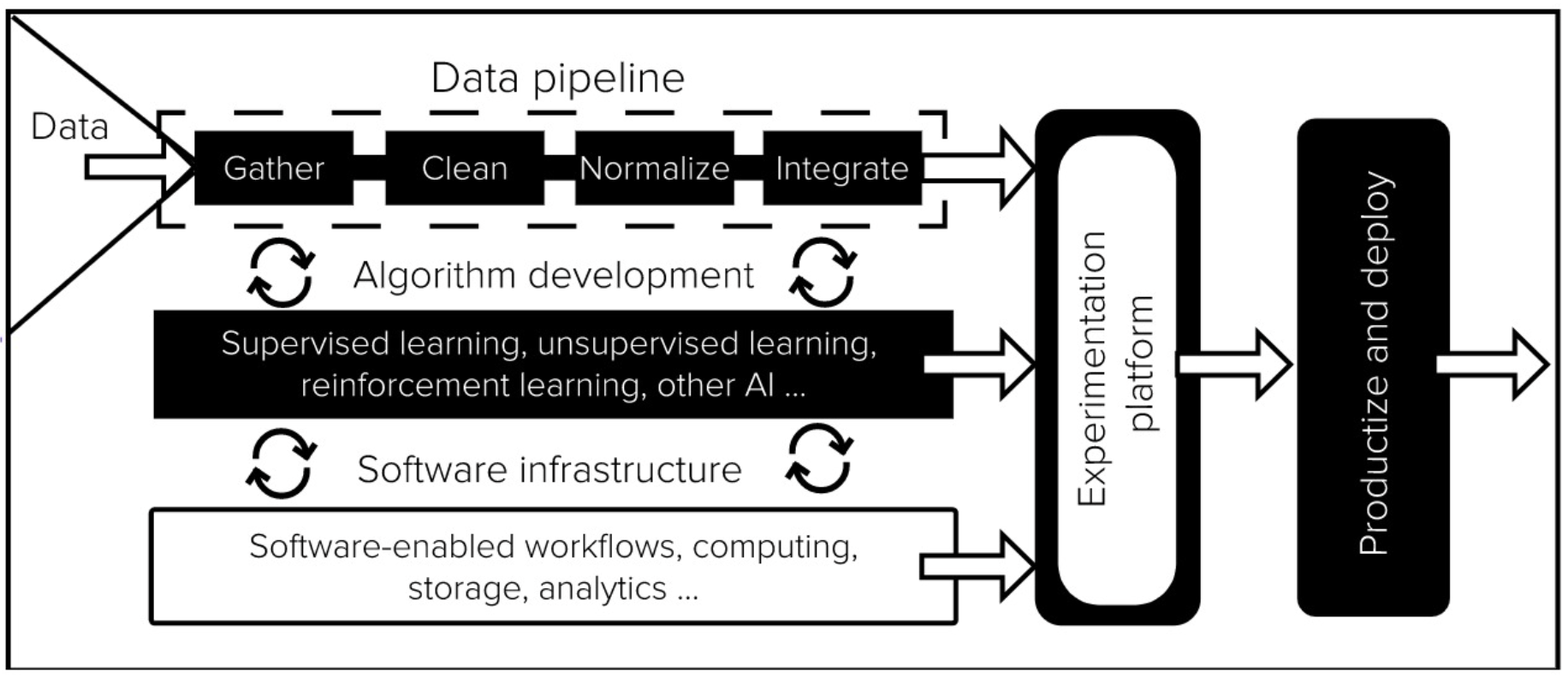
- Data pipeline: Captures data, sanitise and process for use case
- Algorithm development: Heart beat of digital firm that generates prediction for business
- Experimentation platform: Where hypothetical predictions are tested in production
- Software infrastructure: Computing infrastructure that connects internal business to external users
A – The Data Pipeline
B – Algorithm Development
Supervised Learning
Unsupervised Learning
Reinforcement Learning
C – The Experimentation Platform
D – Software, Connectivity and Infrastructure